Our activities

Working Groups

The network’s objectives are largely achieved thanks to the efforts of members grouped together in working groups.

Working groups bring together MEDAE network members interested in contributing to a specific area of interest. These working groups pool knowledge and know-how to organize activities or produce documents. Working groups are designed to produce results, and are organized around a specific project. As such, they are periodic and evolving: they are created for a specific project, and come to an end once the work has been completed. Working groups can address thematic or cross-functional issues.

There are currently 3 working groups. Others may be set up in line with members’ needs and the network’s objectives.

Membership working group

This working group was set up in January 2024, at the start of the network’s activities, to consider membership processes and the network’s framework documents. 

For more information and to join this working group, contact the coordinator: animation@medae-agroecology.eu

Communication working group

This working group was created in January 2024 to reflect on internal communications strategies (mail list, cloud for document sharing, etc.) and those external to the network (logos, website, graphic charter, etc.).

For more information and to join this working group, contact the coordinator: animation@medae-agroecology.eu

Advocacy working group

This working group has not yet been set up. It will bring together different members in order to develop political-scientific advocacy in favor of agroecology, which is a key MEDAE objective. It will contextualize advocacy in response to the issues identified in each region, identify advocacy targets and reflect on advocacy strategies for each target.

For further information, please contact the coordinator: animation@medae-agroecology.eu

Production

The MEDAE network carries out a number of production which are shared here

Every 6 months , the MEDAE newsletter will present recent activities and publications, as well as upcoming news and events.

Newsletter #1

Newsletter #2

Newsletter #3

Subscribe the Newsletter

Subscribe to our newsletter and stay up to date with all the news

The MEDAE network organizes webinars for all those interested in the agroecological transition in the Mediterranean.

2025

How can agroecology be a lever for women’s emancipation in North Africa ?

De quelle manière l’agroécologie peut-elle constituer un levier pour renforcer l’émancipation des femmes en Afrique du Nord ?

(22/04/2025)

2024

What are the prospects for supporting the deployment of agroecology in public policies in North Africa?

Quelles sont les perspectives de soutien au déploiement de l’agroécologie dans les politiques publiques en Afrique du Nord ?

(realized on 26/11/2024)

2023

How to enhance the role of women in mountain agroforestry systems in North Africa?
(realized on 24/10/2023)

How can we promote the development and marketing of agro-ecological products in peri-urban areas?
(realized on 09/11/2023)

Between traditional and scientific knowledge, how can we improve the resilience of peri-oasis systems?
(realized on 23/11/2023)

Climate change: a catalyst for the agro-ecological transition of cereal crops in North Africa?
(realized on 07/12/2023)

The agro-ecological transition as seen by stakeholders in the field: between challenges and achievements. The case of the irrigated valley of Luxor, Egypt
(realized on 14/12/2023)

2025

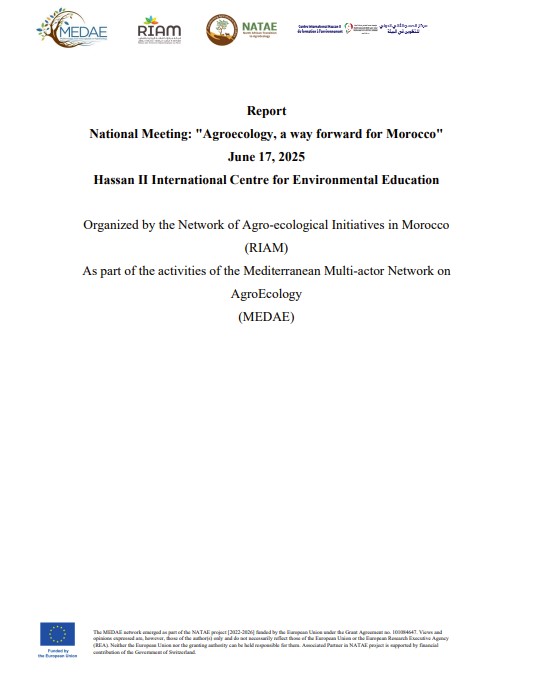
  • Agroecology, a way forward for Morocco (17/ 06/ 2025) (Organized by RIAM Morocco)

This meeting brought together key actors of the agricultural sector, government representatives, agroecology experts, representatives of international organizations, farmers, consumers and members of civil society, with the main objective of responding to the issues and challenges of an agroecological transition in the face of the effects of climate change in Morocco and North Africa (chronic drought,  loss of biodiversity, soil degradation). After an introductory conference, the seminar consisted of 3 panels to (i) highlight the importance of agroecology as a sustainable agricultural approach, at the crossroads of traditional knowledge and scientific innovations; (ii) provide feedback on resilient and sustainable agroecological practices and initiatives; (iii) discuss public policies and strategies to promote agroecology in Morocco. The seminar concluded with a list of recommendations to accelerate the agroecological transition.

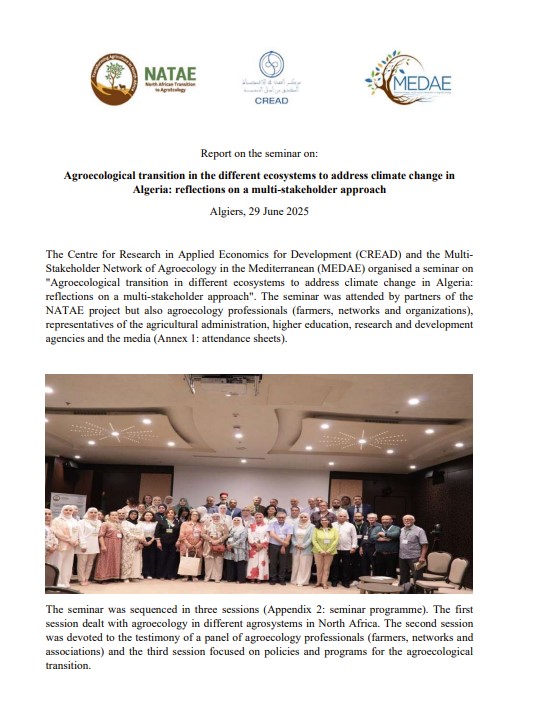
  • Agroecological transition in the different ecosystems to address climate change in Algeria: reflections on a multi-stakeholder approach (29/06/2025) (Organized by CREAD, Algeria)

The seminar was attended by partners of the NATAE project but also agroecology professionals (farmers, networks and organizations), representatives of the agricultural administration, higher education, research and development agencies and the media.

The seminar was sequenced in three sessions (Appendix 2: seminar programme). The first session dealt with agroecology in different agrosystems in North Africa. The second session was devoted to the testimony of a panel of agroecology professionals (farmers, networks and associations) and the third session focused on policies and programs for the agroecological transition.

  • Water resources in the oases of North Africa: acting at the collective and individual levels for reasoned management (17/11/2025) (Organized by Tenmiya)

This seminar focused on water resource management in oases in North Africa, drawing on examples from Mauritania, Tunisia and Algeria. In the oases, water is a precious and indispensable resource for farming in these arid areas. Today, the oases are facing a water crisis due to the combined effects of global warming (reduced rainfall and increased droughts), increased abstraction (agricultural expansions, more water-intensive crops), and the destruction of traditional water governance and management systems.

This seminar has been organized around round tables bringing together farmers, researchers, development operators and public institutions to discuss the challenges related to the scarcity of water resources and practices to manage water sustainably in oases, at the collective (land use planning) and individual (within farms) scales. Group work were organized to identify the obstacles and recommendations for a wider deployment of these practices.

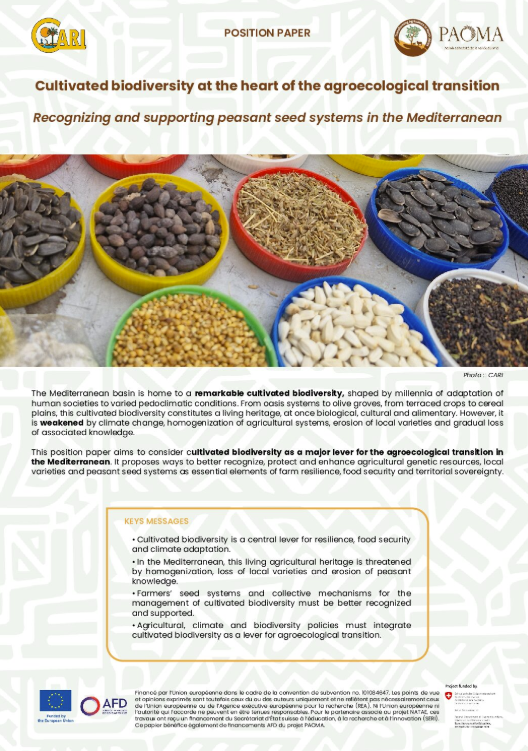
Analysus of Agroecological

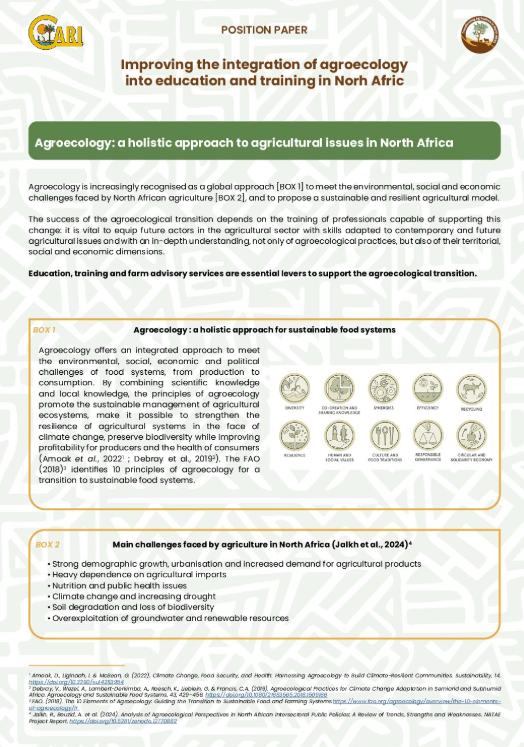
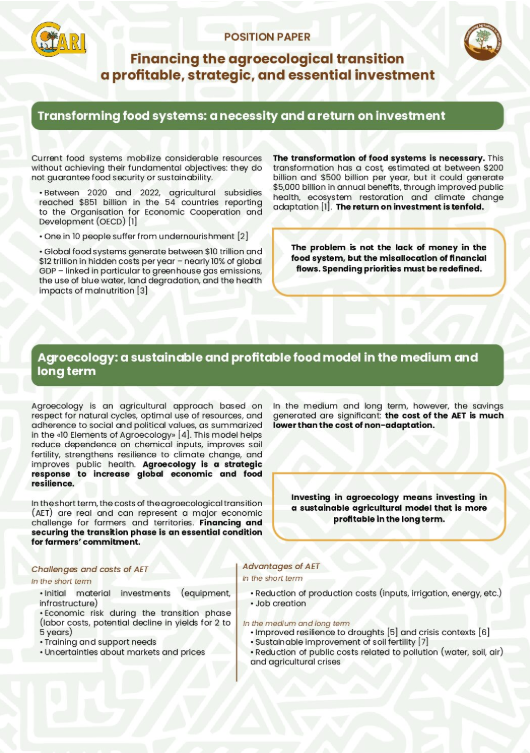
Analysis of Agroecological Perspectives in North African Intersectoral Public Policies

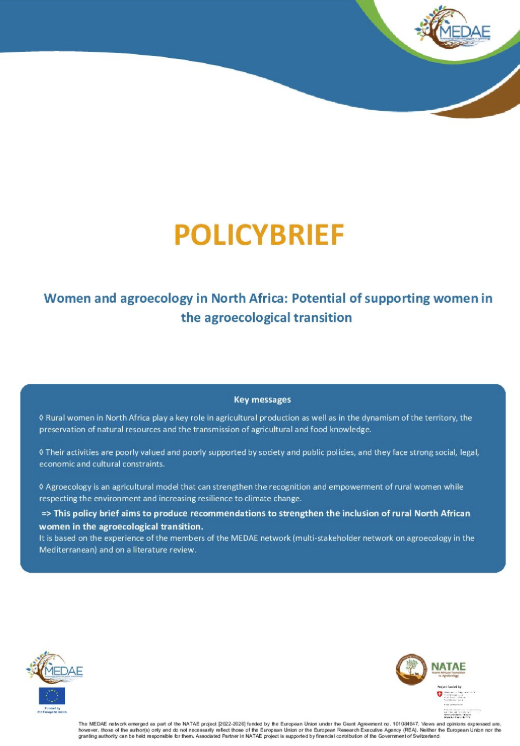
Policy brief - Women and agroecology in North Africa: Potential of supporting women in the agroecological transition.

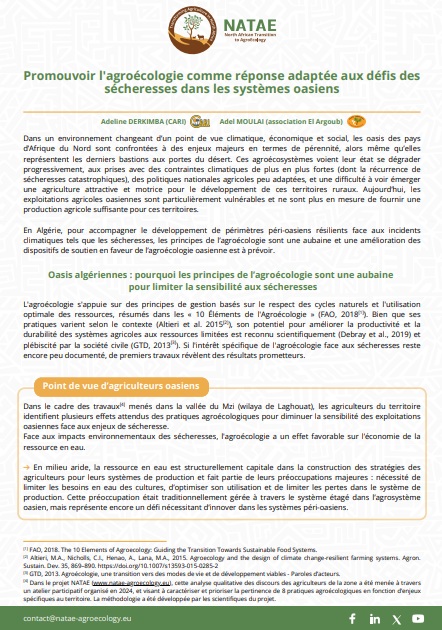
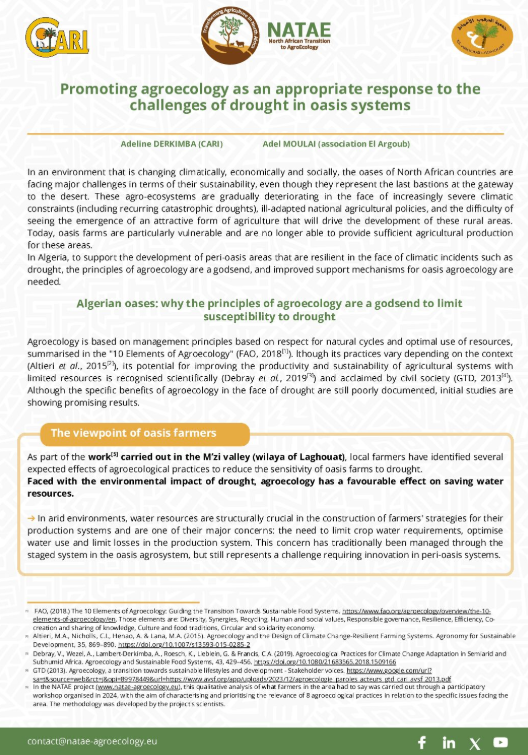
Adeline Derkimba (CARI), Adel Moulai (association El Argoub), Promouvoir l’agroécologie comme réponse adaptée aux défis des sécheresses dans les systèmes oasiens.

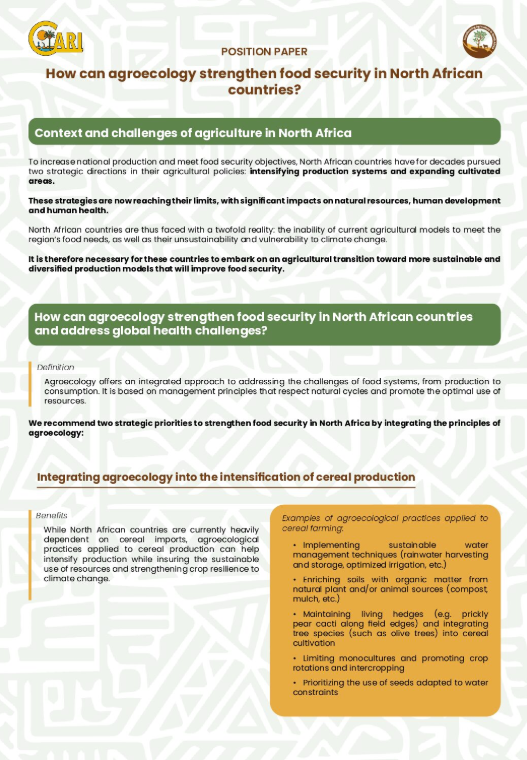
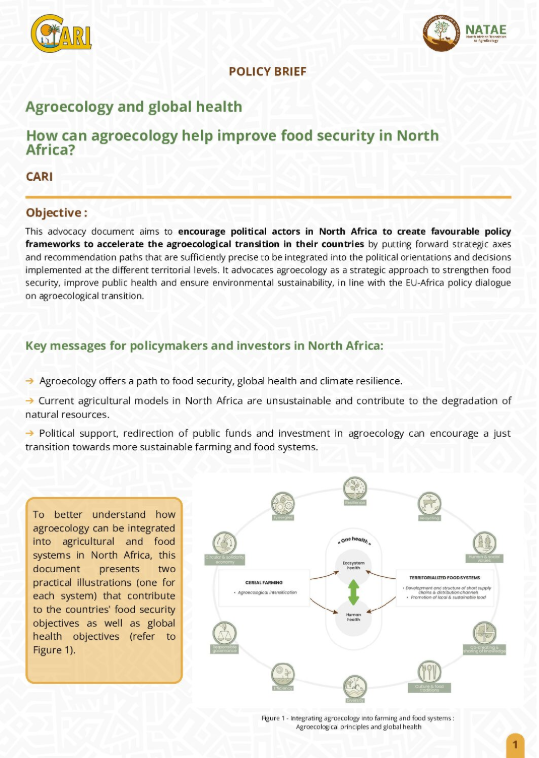
Policy brief - Agroecology and global health. How can agroecology help improve food security in North Africa?

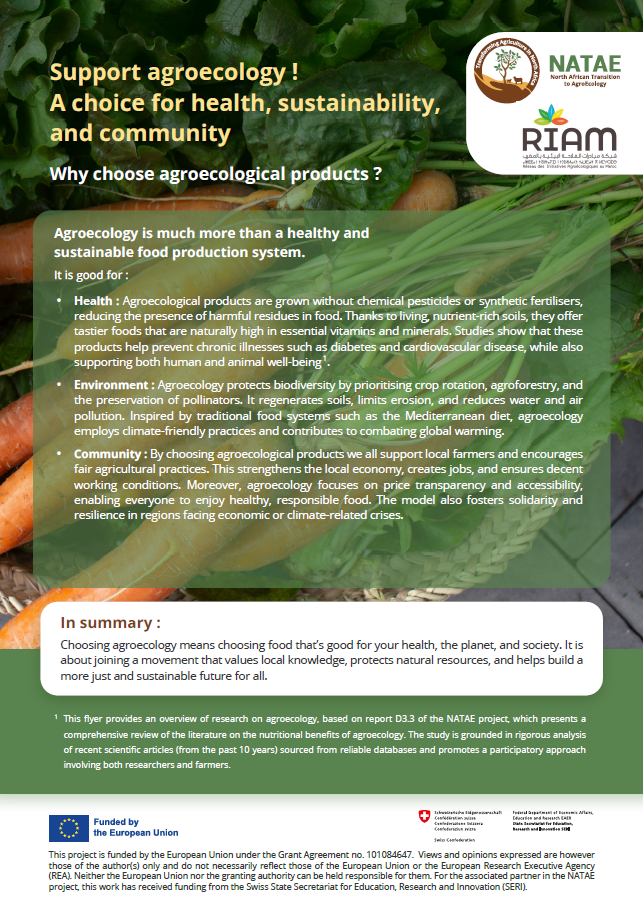
RIAM. Support agroecology ! A choice for health, sustainability, and community

These technical datasheets, created by the NATAE project, can be used as a valuable resource by farmers, researchers, policy makers, and other stakeholders interested in adopting or promoting agricultural practices that contribute to sustainability, productivity, and competitiveness in the agricultural sector. These technical datasheets are classified according to main agroecological principles. They are adapted to several agrosystems specified at the top of each of them. 

Diversity
Diversity
food-traditions
Circular economies. Culture and food traditions
Co-Creation
Co-creation and sharing of knowledge. Human and social values

The MEDAE network lists here the platforms and resource centers around the agroecological transition.

Feel free to share your resource centers with us to add them!

Agroecology Knowledge Hub (by FAO)

FAO has developed this web-based platform to highlight and share relevant knowledge on agroecology. As agroecology has been identified as an integration of science, practices and social processes this platform provides updates on current states of knowledge on these three aspects. In addition to knowledge materials, the Hub also hosts AgroecologyLex which is a specialized database on different legal frameworks, policies and programmes concerning agroecology in different countries. It was created in coordination with FAOLEX, which is the largest database on policies and legislation related to agriculture and renewable natural resources in the world.

Boost AE (by CIRAD)

Boost is a collaborative platform for bringing actors together, sharing knowledge and solutions between them, and methodological support, for an agroecology adapted to tropical areas and countries of the South.

Centre de ressource numérique (by Agrisud International)

This resource centre is composed of a media library and an E-learning programme with free access. The documentation, videos and training provided are all the result of the capitalization of the experiences of Agrisud and its partners in several countries in Africa, Asia, Latin America and the Caribbean. These resources are intended for professionals, students, local authorities, etc. who work for the agro-ecological transition.

Centre de ressource (by CARI)

The CARI Resource Centre gather factsheets, videos, reports, advocacy documents, etc. on agroecology, desertification, land degradation, the Great Green Wall, and oases. These documents were produced by CARI and its partners as part of their projects.

Access agriculture

This platform provides quality learning videos in local languages to promote organic farming and agroecology.

ALISEA Knowledge Hub

The ALiSEA Knowledge Hub is an open-access online platform that consolidates and shares resources, expertise, and practical information on agroecology in the Mekong Region. It offers a collection of knowledge products, a document library, maps, data visualizations, and a directory of agroecology experts with content available in English and national languages.

OSAE

OSAÉ is a center for sharing technical knowledge and know-how in agroecology. This site is based on concrete examples and presents testimonies of French farmers who are experimenting with solutions to initiate transitions.

News and Events