Offre de stage – Master 2 : Evolution des pratiques alimentaires dans les ménages urbains, région de Meknès, MarocContexteLe projet M ...
Resources
The MEDAE network will produce resources, some of which will be shared here.
- Newsletters
- Newsletters
- Webinars
- Publications
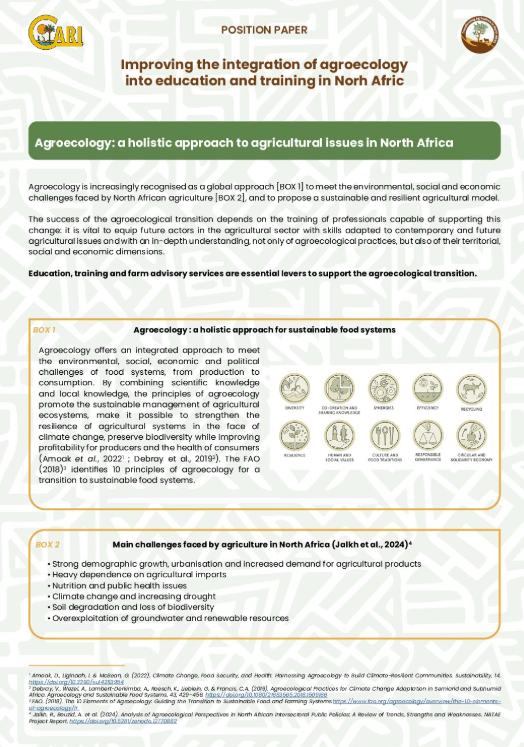
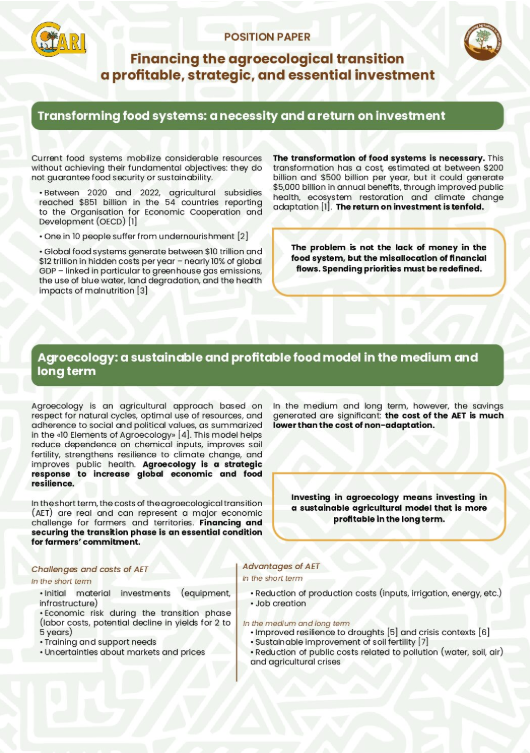
- Position papers and policy briefs
- Technical datasheets
- Other resources
Every 6 months , the MEDAE newsletter will present recent activities and publications, as well as upcoming news and events.
Subscribe the Newsletter
Subscribe to our newsletter and stay up to date with all the news
Every 6 months , the MEDAE newsletter will present recent activities and publications, as well as upcoming news and events.
Subscribe the Newsletter
Subscribe to our newsletter and stay up to date with all the news
The MEDAE network organizes webinars for all those interested in the agroecological transition in the Mediterranean.
2025
How can agroecology be a lever for women’s emancipation in North Africa ?
De quelle manière l’agroécologie peut-elle constituer un levier pour renforcer l’émancipation des femmes en Afrique du Nord ?
(22/04/2025)
2024
What are the prospects for supporting the deployment of agroecology in public policies in North Africa?
Quelles sont les perspectives de soutien au déploiement de l’agroécologie dans les politiques publiques en Afrique du Nord ?
(realized on 26/11/2024)
2023
How to enhance the role of women in mountain agroforestry systems in North Africa?
(realized on 24/10/2023)
How can we promote the development and marketing of agro-ecological products in peri-urban areas?
(realized on 09/11/2023)
Between traditional and scientific knowledge, how can we improve the resilience of peri-oasis systems?
(realized on 23/11/2023)
(realized on 07/12/2023)
The agro-ecological transition as seen by stakeholders in the field: between challenges and achievements. The case of the irrigated valley of Luxor, Egypt
(realized on 14/12/2023)
Offres de stage projet MAHDIA (offer 1)
Offre de stage : Animation territoriale et co-construction d’actions pour la transition agroécologique autour de produits d’intérêt territorial – MeknèsCo ...
Appel à contributions pour un dossier thématique des Cahiers Agricultures
"Les formations agricoles dans le monde à l’épreuve de l’agroécologie" Les Cahiers Agricultures lancent un appel à articles pour un d ...
Seminar – Water resources in the oases of North Africa
Seminar Nouakchott, Mauritanie, November 17, 2025 Water resources in the oases of North Africa: acting at the collective and individual level ...
Report on the Seminar, 29 June, Algiers
Agroecological transition in the different ecosystems to address climate change in Algeria: reflections on a multi-stakeholder approach ...
From June 17 to July 20, 2025, take part in the survey on “Measures to address the risk of drought” launched by CARI!
Preparations for the 2026 International Desert Action Summit are continuing! Following the launch of preparatory workshops in many countries, ...
Rencontre Nationale – 17 Juin – « L’agroécologie, une voie d’avenir pour le Maroc »
This event will be in French
Seminar – Agroecological Transition and Climate in Algeria
Seminar Algiers, June 29, 2025 Agroecological transition in different ecosystems to combat climate change in Algeria: ref ...
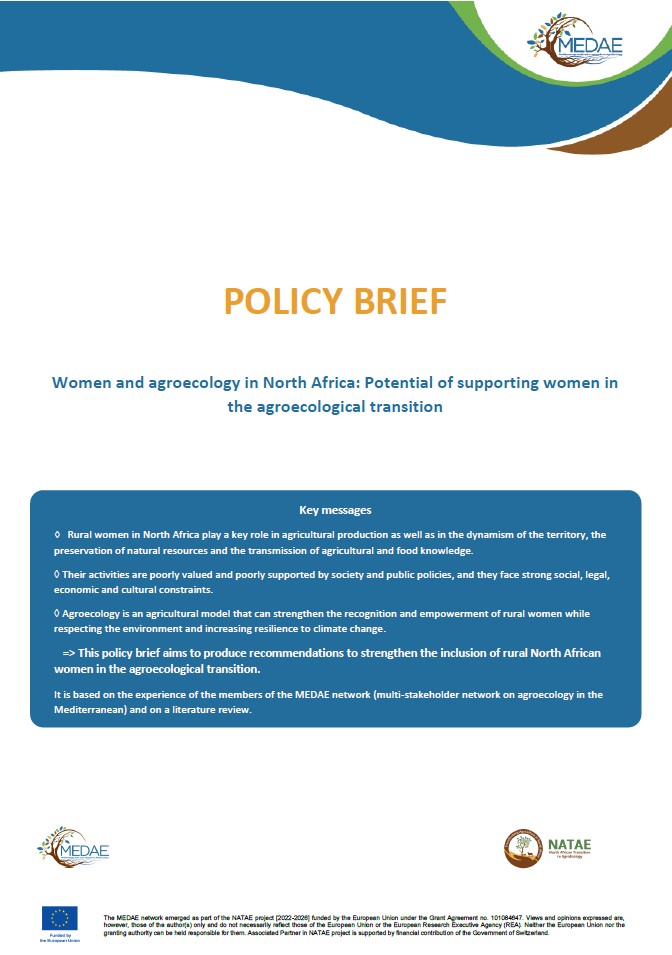
Policy brief - Women and agroecology in North Africa: Potential of supporting women in the agroecological transition.
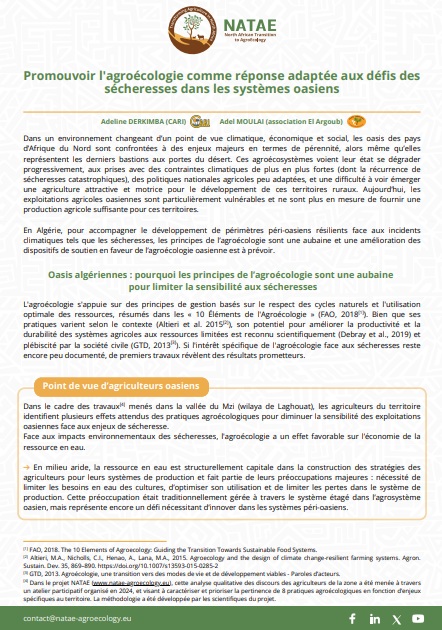
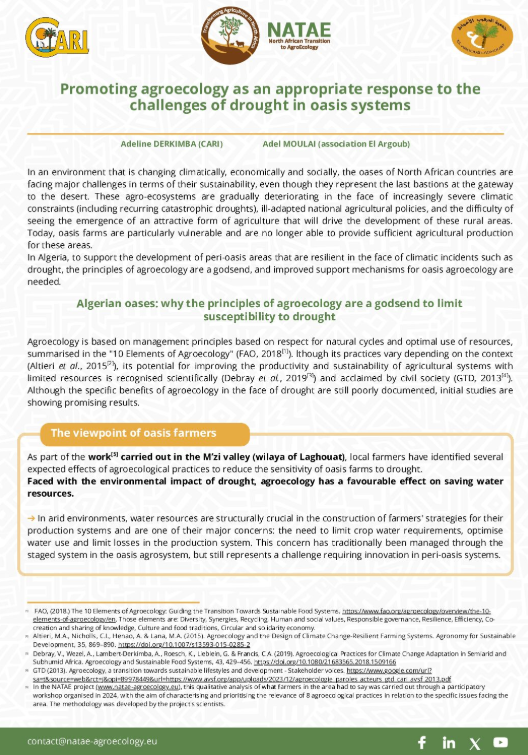
Adeline Derkimba (CARI), Adel Moulai (association El Argoub), Promouvoir l’agroécologie comme réponse adaptée aux défis des sécheresses dans les systèmes oasiens.
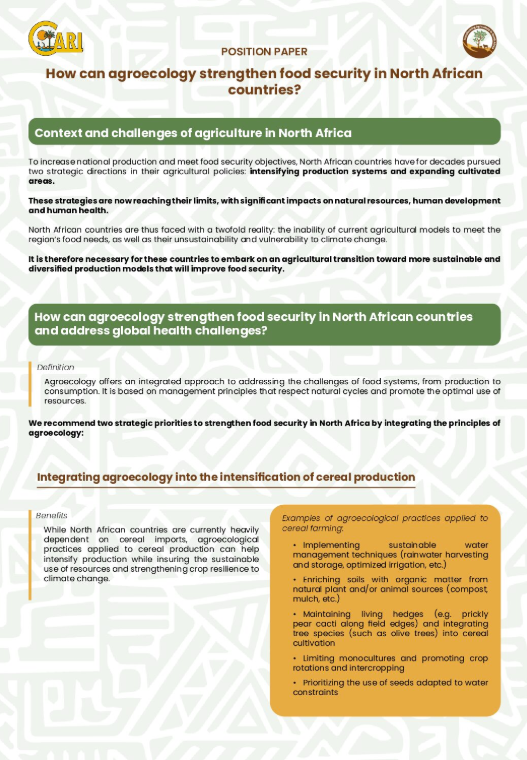
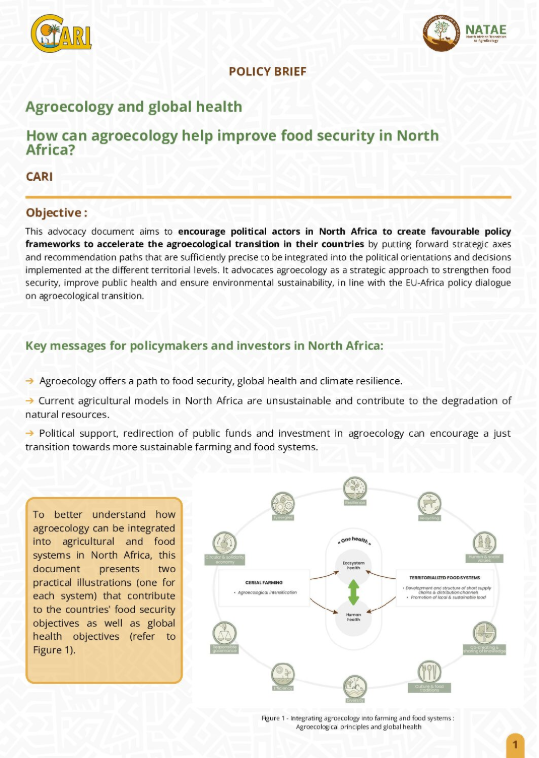
Policy brief - Agroecology and global health. How can agroecology help improve food security in North Africa?
These technical datasheets, created by the NATAE project, can be used as a valuable resource by farmers, researchers, policy makers, and other stakeholders interested in adopting or promoting agricultural practices that contribute to sustainability, productivity, and competitiveness in the agricultural sector. These technical datasheets are classified according to main agroecological principles. They are adapted to several agrosystems specified at the top of each of them.